Birth Chart Without a Birth Time: What You Can Know
Don't know your birth hour? You can still explore most of your chart. This guide shows what stays reliable, what becomes an estimate and what needs a birth time.
These examples use the Western tropical zodiac.
The same birthday, different information
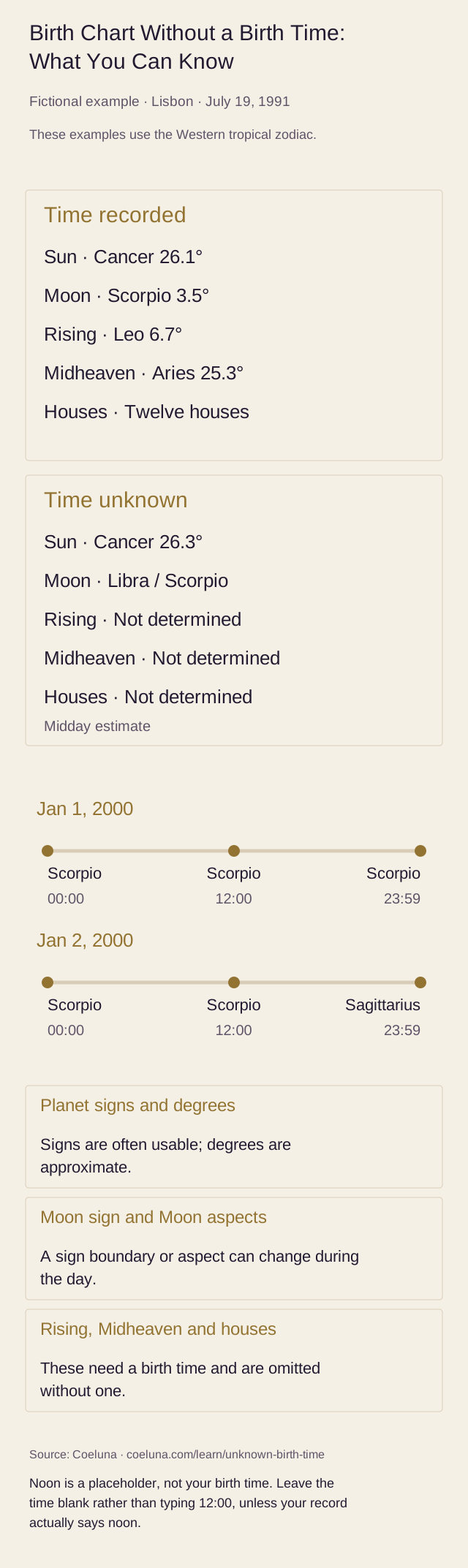
A fictional example born in Lisbon on 19 July 1991. With the time (07:24), the chart is complete. Without it, Coeluna calculates for local noon: the Sun and planets barely move, while Rising, Midheaven and houses are left out.
Your Moon may have one sign—or two possibilities
The Moon moves about 13° a day. On 1 January 2000 in Greenwich it stays in Scorpio all day; on 2 January it enters Sagittarius before midnight. Someone born that day could have either Moon sign.
When you leave the time blank, Coeluna checks the Moon at the start and end of your birth day. If it changes sign, you see both possibilities instead of a guess. Even when the sign stays the same, its exact degree and aspects depend on the hour.
Different parts of a chart need different precision
This is a guide to uncertainty, not a scale of fixed movement speeds. Rising signs do not each take exactly two hours; latitude and the sign change the timing.
Use what you know, keep the uncertainty visible
Noon is a placeholder, not your birth time. Leave the time blank rather than typing 12:00, unless your record actually says noon.
If the Sun or another planet sits in the first or last degree of a sign, it may have been in the neighbouring sign at another hour of your birth day.
Treat Moon aspects as approximate. Appearance or personality can't reliably reveal your Rising sign; only a birth time can.
If you find your birth time later, simply calculate again. Birth certificates, hospital records and family papers are the best sources; a time worked out by an astrologer (rectification) is still an estimate.